The right material decides whether your part holds up.

We print with a wide range of plastics, enjoy trying new ones and choose the material for how your part will be used, not out of habit. Here are the most important ones with their strengths and limits.

No obligation · we usually reply within one working day

  • Mostly PLA, PETG and ABS-PC
  • Many colors in stock
  • Happy to test new ones

From the use to the material

Tell us what your part has to withstand. These rules of thumb help with a first assessment.

  • Outdoors, sun and weather

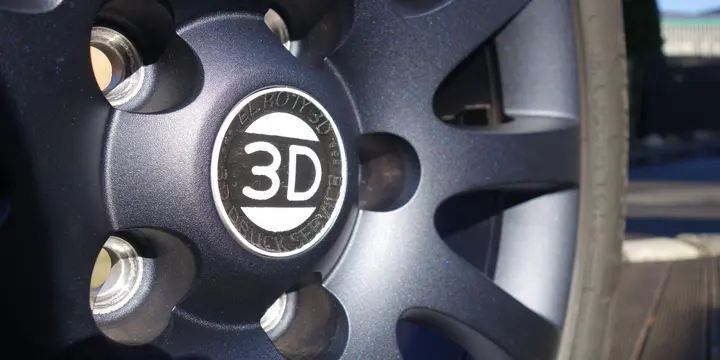
    PETG has proven itself for us: hub caps have withstood sun, brake dust and harsh wheel cleaners for years.

  • Heat, for example in a car

    PETG has proven itself inside cars, ABS-PC takes even more heat. PLA softens from about 55 °C.

  • Movement and wear

    PA (nylon) for gears, sliding parts, hinges and snap fits.

  • Stiff and light

    Fibre-reinforced plastics such as PA-CF for jigs and structural parts.

  • Flexible and damping

    TPU for seals, buffers, grips and protective covers.

  • Looks and prototypes

    PLA for sharp details, fine surfaces and many colors.

Where the material choice fits into your solution

We settle the material while working out the solution and design the part to suit it. If no plastic fits, partner companies in the region make the part with another process, such as CNC, sheet metal or injection molding.

  1. 01Understand
  2. 02Find the solution
  3. 03Engineering
  4. 04Manufacturing
  5. 05Assembly and testing
  6. 06Delivery

At a glance

Material Strong in Limits Heat up to approx.
PLA accuracy, surface, colors, price heat, impact, UV 55 °C
PETG toughness, moisture, chemicals, outdoors fine detail 70 °C
ABS heat, post-processing warping, UV 95 °C
ASA weather and UV, heat warping, price 95 °C
ABS-PC impact strength, heat warping 110 °C
PC impact strength, heat, transparency demanding, price 115 °C
PA (nylon) toughness, abrasion, sliding absorbs moisture 80–150 °C
Fibre-reinforced (CF, GF) stiffness, accuracy, weight more brittle on impact, price depends on base
TPU flexibility, damping, abrasion accuracy, print time 80 °C

Temperatures are guide values for lightly loaded parts. They depend on the manufacturer, the load and the part’s shape.

Good to know

  • Layers: printed parts are built layer by layer and are slightly weaker between layers. We orient your part so it is strong where the load acts.
  • Build size: not every material can be printed in every size. We tell you in the quote what fits your part.
  • Colors: we keep many colors in stock and source special colors on request.
  • Not listed? Need a material that’s missing here? Ask us. We like testing new ones.
The materials in detail

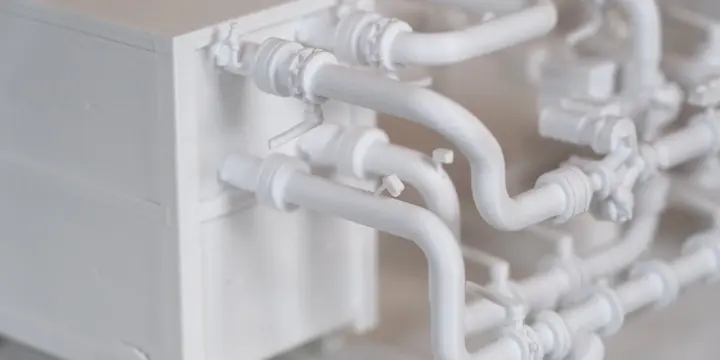
Pipes and valves on a 1:50 plant model printed in PLA

Our standard

PLA

The classic. PLA prints very accurately, has a fine surface and comes in almost every color, including silk, matte and metallic effects. It is stiff and affordable.

Strengths
dimensionally accurate, sharp detail, wide color range, affordable
Limits
softens from about 55 °C (a car in summer!), rather brittle, not UV-resistant outdoors in the long run
Typical for
prototypes, display and architectural models, mock-ups, decoration
PETG hub cap on an alloy wheel, in use for years

Our standard

PETG

Our robust all-rounder. PETG is tougher than PLA, handles moisture and many chemicals, and takes more heat. Our PETG hub caps have withstood sun, brake dust and harsh wheel cleaners for years. It also comes clear and in colored transparent.

Strengths
tough and impact-resistant, resistant to moisture and chemicals, proven outdoors, good layer adhesion
Limits
slightly less sharp detail than PLA, up to about 70 °C
Typical for
functional parts, holders, housings, outdoor parts, vehicle parts inside and out
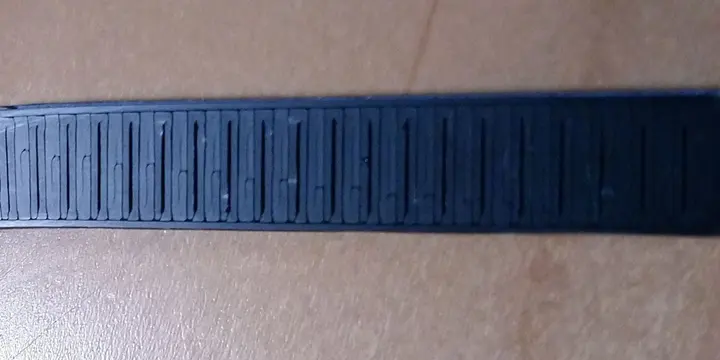
Close-up of an ABS-PC profile with fine ribbing

Our standard

ABS-PC

A blend of ABS and polycarbonate. It combines the easy processing of ABS with the impact strength and heat resistance of PC.

Strengths
very impact-resistant, heat-resistant up to about 110 °C
Limits
tends to warp, more expensive
Typical for
heavily loaded housings, holders, clips

TPU

Flexible and rubber-like. TPU absorbs shocks, resists abrasion and returns to its shape after deformation.

Strengths
flexible, damping, abrasion-resistant, tough
Limits
less dimensionally accurate than rigid plastics, slower to print
Typical for
seals, bumpers, protective cases, grips, feet

PA (nylon)

Tough, abrasion-resistant and with good sliding properties. PA handles repeated loads well without breaking.

Strengths
very tough, abrasion-resistant, low friction, fatigue-resistant
Limits
absorbs moisture from the air, which slightly changes dimensions and stiffness
Typical for
gears, sliding parts, hinges, snap fits

ABS

Proven in industry. ABS is tough, withstands higher temperatures and is easy to sand, glue and paint.

Strengths
heat-resistant up to about 95 °C, tough, easy to post-process
Limits
large parts tend to warp, not UV-resistant
Typical for
technical parts, housings, vehicle interior parts

ASA

ABS for outdoors. ASA has mechanical properties similar to ABS but keeps its shape and color in sun and weather.

Strengths
UV- and weather-resistant, heat-resistant, tough
Limits
tends to warp, more expensive than PLA and PETG
Typical for
outdoor parts, vehicle exterior parts, garden and facade parts

PC (polycarbonate)

One of the strongest plastics in 3D printing. PC is very impact-resistant, withstands high temperatures and can be transparent.

Strengths
very impact-resistant, heat-resistant up to about 115 °C, stiff
Limits
demanding to print, sensitive to moisture before printing, more expensive
Typical for
parts under mechanical and thermal load, protective covers

Fibre-reinforced plastics

Short carbon or glass fibres in PA, PETG or other plastics (for example PA-CF) make parts much stiffer and more dimensionally stable. The surface turns matte and refined.

Strengths
very stiff, light, dimensionally stable, little warping
Limits
less impact-resistant than the plain material, more expensive
Typical for
jigs and fixtures, holders, stiff and light structural parts

Frequently asked questions about materials

Which material survives in a car in summer?

Not PLA, which softens from about 55 °C. Inside the car, PETG has proven itself for us. Where it gets even hotter, we use ABS-PC.

Which material is suitable for outdoor use?

PETG. Our PETG hub caps have withstood sun, brake dust and harsh wheel cleaners for years. For especially high demands on color stability under UV light, there is ASA.

Which material is the strongest?

That depends on the load. ABS-PC is our first choice against impact, fibre-reinforced plastics for stiffness, PA for repeated load and wear. We also orient the part so it is strong where the load acts.

Can I choose any color?

We keep many colors in stock and source special colors on request.

What if no plastic fits?

Then we tell you openly. Parts that need another material or process are made by partner companies in the region, and we stay your contact.

Not sure which material fits?

Tell us what your part is for: load, temperature, indoors or outdoors. We'll recommend the right material.

Discuss your project

No obligation · we usually reply within one working day